Last Modified on: Tuesday, June 16, 2026
Thank you for scanning the QR code! By the way, did you read what the QR code was gonna do before you tapped open? If not, might want to make that a habit to protect yourself from malicious QR codes.
Here you can find a questionnairecoming soon to fill out, please do so only once.
Below is more or less the presentation you witnessed. With some details added and some removed.
A Phone for the Consumer, Not the Company.
• User Owned
• Made in the USA completely is the goal
Table of Contents
• Missions and Values
• The Problem
• The Solution
• Why GrapheneOS
• Cellebrite Leak
• Market Opportunity
• Go-to-Market Strategy
• Competitive Landscape
• Vision
• Team and Supporters
• The Ask
• FAQ
Missions and Values
Two Missions:
Three Values:
The Problem
You Don't Actually Own Your Phonewhich you paid for...
No True Ownership
Manufacturers & carriers control what you are allowed to install, which apps are forced on your phone (can’t remove and/or disable), and the permissions granted for those apps that are forced upon you — even after you've paid $1,000.
Examples:
• Google’s Play Integrity API and Apple’s Attest API
• Samsung One UI 8.5 changes button layout and dark color scheme. You cannot change it back. There are apps to allow one to change the color scheme to their liking, but One UI prevents it from working. That should, again, be your choice since you paid for the phone.
Vulnerable By Design
Most Android phones are vulnerable to Cellebrite & Grayshift forensic tools. MediaTek SoC specific exploits (i.e. CVE-2026-20435) routinely compromise the user’s device.
Companies do try to secure their devices, they are not a fan of these forensic tools either, but because they want control over the device still there is vulnerabilities that can be exploited.
Forced Obsolenscence
Premium devices get only 2–4 years of feature and security updates (respectively), leaving users exposed. Even the new 7-year promise is unproven.
Remember Apple and Samsung being sued about a decade ago? They got caught purposely pushing out updates to slow down their devices, with the intent to drive users to upgrade. They claim it was to protect the aging battery, but again, that should be the owner's choice if they want to use their device as is or take the manufacture's recommendation to restrict the device's capabilities.
We do not share this sentiment. If you pay money for something, it is yours and cannot be taken away.
The Solution
The Carbon Ghost
The price? Flagship pricing, about $1K. We do have plans to make a budget friendly phone and a no compromises phone.
The best part? When you give us the money and we give you the box with the phone in it, that is it. It is your device and you can do whatever you want with it.
Why GrapheneOS
Security by Default
App Sandboxing
Apps are isolated from one another. One app cannot see what other apps are installed and cannot see data outside what is designated for them (the user can increase the app's permissions to see more files, if they choose to).
Zero Bloatware
No pre-installed apps. No forced permissions.
If you got a Samsung, go into your Settings and then into Apps. Look for an app called Modes and Routines. You cannot uninstall it. You cannot disable it. And you cannot revoke its permissions. One of its permissions is Location data all the time. Another is contacts.(This was checked and true on S25 on May 25, 2026 running Android 16 and One UI 8.5)
Open Source
You can audit the code to know that nothing is being done without your knowledge.
If you do not read code, that is okay. You can still go to the code and read how other tech experts feel about the code. You still get to know this way that nothing suspisious is going on.
The cherry on top? You can take that code and compile it and install it yourself. That way you do not even have to trust us. You can just do it yourself. All of this is your choice, you decide what you want to do.
Forensic Tool Resistant
Malicious actors get into your phone by exploiting vulnerabilities. So does forensic tools like Cellebrite and Grayshift, used by law enforcement.
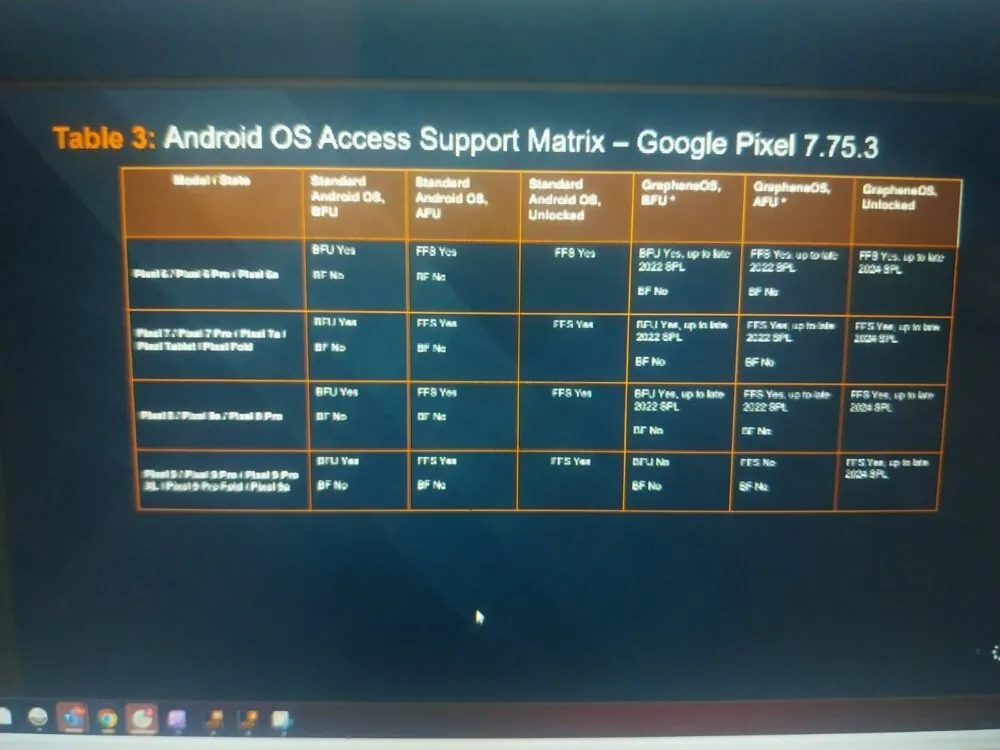
To us, it does not matter if they are the good guys or the bad guys, no one should be allowed into your phone without your permission and consent. Cellebrite had a presentation slide leaked back in 2025 (shown below). It shows that they could not get into a Google Pixel Phone running GrapheneOS. We call that pretty well darn secure.
| Model | State | Standard Android OS, BFU | Standard Android OS, AFU | Standard Android OS, Unlocked | GrapheneOS, BFU * | GrapheneOS, AFU * | GrapheneOS, Unlocked |
|---|---|---|---|---|---|---|
| Pixel 6 / Pixel 6 Pro / Pixel 6a | BFU: Yes BF: No |
FFS: Yes BF: No |
FFS: Yes | BFU: Yes, up to late 2022 SPL BF: No |
FFS: Yes, up to late 2022 SPL BF: No |
FFS: Yes, up to late 2024 SPL |
| Pixel 7 / Pixel 7 Pro / Pixel 7a / Pixel Tablet / Pixel Fold | BFU: Yes BF: No |
FFS: Yes BF: No |
FFS: Yes | BFU: Yes, up to late 2022 SPL BF: No |
FFS: Yes, up to late 2022 SPL BF: No |
FFS: Yes, up to late 2024 SPL |
| Pixel 8 / Pixel 8 Pro / Pixel 8a | BFU: Yes BF: No |
FFS: Yes BF: No |
FFS: Yes | BFU: Yes, up to late 2022 SPL BF: No |
FFS: Yes, up to late 2022 SPL BF: No |
FFS: Yes, up to late 2024 SPL |
| Pixel 9 / Pixel 9 Pro / Pixel 9 Pro XL / Pixel 9 Pro Fold / Pixel 9a | BFU: Yes BF: No |
FFS: Yes BF: No |
FFS: Yes | BFU: No BF: No |
FFS: No BF: No |
FFS: Yes, up to late 2024 SPL |
BFU (Before First Unlock): The phone has been restarted or first turned on from power off state and the passcode has yet to be entered.
AFU (After First Unlock): The phone is locked, but the phone has had the password entered before. Most common state the phone is in for most people.
FFS (Full File System): The ability to extract any and all data on the phone.
BF (Brute Force): This is a method of breaking into a phone without knowing the password. Just keep guessing until access is gained. ‘BF: No’ means that brute forcing is not possible due to some security measure that detects and prevents brute force attacks.
SPL (Security Patch Level): Which version of OS security patch update is running.
Basically this whole table means that GrapheneOS cannot be Brute Forced into AND No data is leaked after late 2022 for Before First Unlock and after late 2024 for Unlocked Bootloader.
Market Opportunity
5.5 Million
Global CyberSecurity Professionals
1.34 Million
U.S.A. CyberSecurity Professionals
33%
Expected Growth through 2034
$1.34 Billion
Full U.S.A. Market Capture Potential (not calculating the potential skill gap)
Initial U.S.A. Market Capture Goal
3%
40K Units
~$40 Million Valuation
Go-to-Market Strategy
Step 1
Questionaire
A questionaire is under way to gather data on smart phone users really want out of their phones and what they are willing to pay. Using this information to determine where to focus on the hardware side of things for this prototype.
Like do people care more about a high-resolution camera or a large battery or very powerful processor.
Step 2
Design & Prototype
Develop and Build a prototype.
The goal is to partner up with universities, like Georgia Tech, to have graduate students design and produce the prototypes.
Then initial tests will be to determine if the Android Open Source Project (AOSP) can be installed and running. Once that is accomplished, go a step further and install GrapheneOS.
Once GrapheneOS is installed, there are two goals: One is to partner up with universities again, like Georgia Tech and University of North Georgia, and have them try to break the security. The second goal is to send a prototype to the GrapheneOS developers and have them be onboard in assisting to support it.
Step 3
Beta Launch
~30-100 beta units will be created and sent out to Super Targets. We will gather field feedback and go back to step 2 and iterate new designs and prototypes based on that feedback.
Super Targets are targets that are believed to have the biggest impact on feedback/further development and/or the biggest impact on further sales/customer acquisition.
Examples:
• Dr. Bryson Payne and his recommendations.
• Dr. Tamirat Abegaz and his recommendations.
• Dr. John David Rusk and his recommendations.
• Ben Williams and his recommendations.
• Influencers (YouTube/TikTok/LinkedIn etc.): • Cybersecurity/Privacy Advocates (Hak5, Network Chuck, Seytonic) • Smartphone Reviewers (Mrwosetheboss, MKBHD) • JerryRigEverything (Phone Durability Testing)
• Government, like local DCS or local Sherrif Office or Military. Goal to get into the hands of NSA/FBI/DoD(DoW).
Step 4
Soft Launch
Create 10,000 initial units and get them sold. Based on how they sell we will create more units, with the goal of selling an additional 30K units at least.
The channels we plan to utilize to sell are:
• Direct-to-Consumer
• Retail Partners (like Micro Center, Best Buy, Walmart)
• Cellular Carriers
• Enterprise Contracts
• Government Contracts
Competitive Landscape
U.S.A. Market Share (2025)
■ Apple (57.5%)
■ Samsung (22.3%)
■ Motorola (11.3%)
■ Google (3%)
■ Others (5.9%)
Our direct competitor is going to be the Google Pixel because it is the only device that supports GrapheneOS officiallyas of May 26, 2026.
The Vision
We plan to go much further than just being a phone manufacture.
Step 1
Carbon Cloud
Provide cloud services, similar to Google/Microsoft/Apple, that is private and secure. One company is already doing this, Proton. They just should not be the only one.
maybe we will team up with them also ;)
Step 2
Carbon App Store
Imagine an app store that does not have malicious apps on it, ever.
Extremely difficult, if not impossible to do, but we got some ideas on how to accomplish that.
Still in the idea phase.
Step 3
Carbon OS
You know how Apple computers and Apple iPhones and other Apple devices just simply work together smoothly.
Imagine your Carbon Ghost works that well with your computer. We believe it is possible and plan to implement this goal.
Step 4
Carbon Net
Some day, imagine an Internet Service Provider (ISP) that provides private, reliable, fast connectivity. No matter where you are located. We plan to bring Fiber to every home every where. It is 2026(at time of writing), there is no excuse as to why this has not been accomplished yet. And it will be ~$100/month for 1Gbps in both directions.
There is no limit how far we will go.
Team & Supporters
Matthew
Founder & Visionary
• Cybersecurity Major from the University of North Georgia
• Published Cyber Capstone
• Strong Curiosity & Eager to Learn
Dr. Bryson Payne
Board Advisor | Hardware Security Field Test Supervisor
• Award-Winning Cybersecurity Professor & Researcher (And a Mentor)
• Certifications: GREM, GPEN, GRID, CEH, CISSP
• Published Books: Go Hack Yourself, Teach Your Kids to Code, Learn Java the Easy Way
Ms. Caitlin Marcelino
Board Advisor
• NYU MBA Graduate
• Multi-Time Entrepreneur: 4alivio, Grandma Jean's Bakery
• The main reason The Carbon Ghost is beyond just an idea.
The Ask
We are seeking $1 Million.
• ~13% goes to beta launch inventory.
• ~6% goes to marketing
• ~1% goes to legal
• ~1% goes to GrapheneOS directly.
• ~4% goes to R&D.
If partnerships are successfully arranged with universities, this $1 Million will last 4x as long and help get to market quicker.